





With so many computing options available, choosing the most suitable technology solution can be challenging. The need for investment in every improvement or change adds another layer of complexity. Should your business rely on an on-premises infrastructure, take advantage of cloud functionality, or opt for a hybrid approach? The right choice depends on both your business needs and technical requirements. Drawing on our extensive experience with diverse software solutions, DigitalMara has prepared this guide exploring key factors when choosing between SaaS and on-premises systems and providing actionable insights.
Let’s dive deeper into these approaches:
- SaaS (Software as a Service) is a cloud-based application hosted by a third-party vendor and accessed via the internet. This approach eliminates the need for in-house servers and provides access to cloud technology capabilities.
- On-premises software is installed and runs on servers within the company’s own infrastructure. This model gives businesses full control over their data and security protocols, and fulfills specific technical needs.
- Hybrid solutions combine elements of both SaaS and on-premises models. They allow organizations to keep sensitive or critical workloads on-premises while leveraging the cloud for other functions.
Key differences between SaaS and on-premises
Each model has its own unique advantages and disadvantages. One model may be preferable to the other in a particular case, depending on functionality needs. The choice will also depend on your technical requirements, budget, and long-term goals. Below is a detailed comparison to help you understand how these approaches differ.
Cost
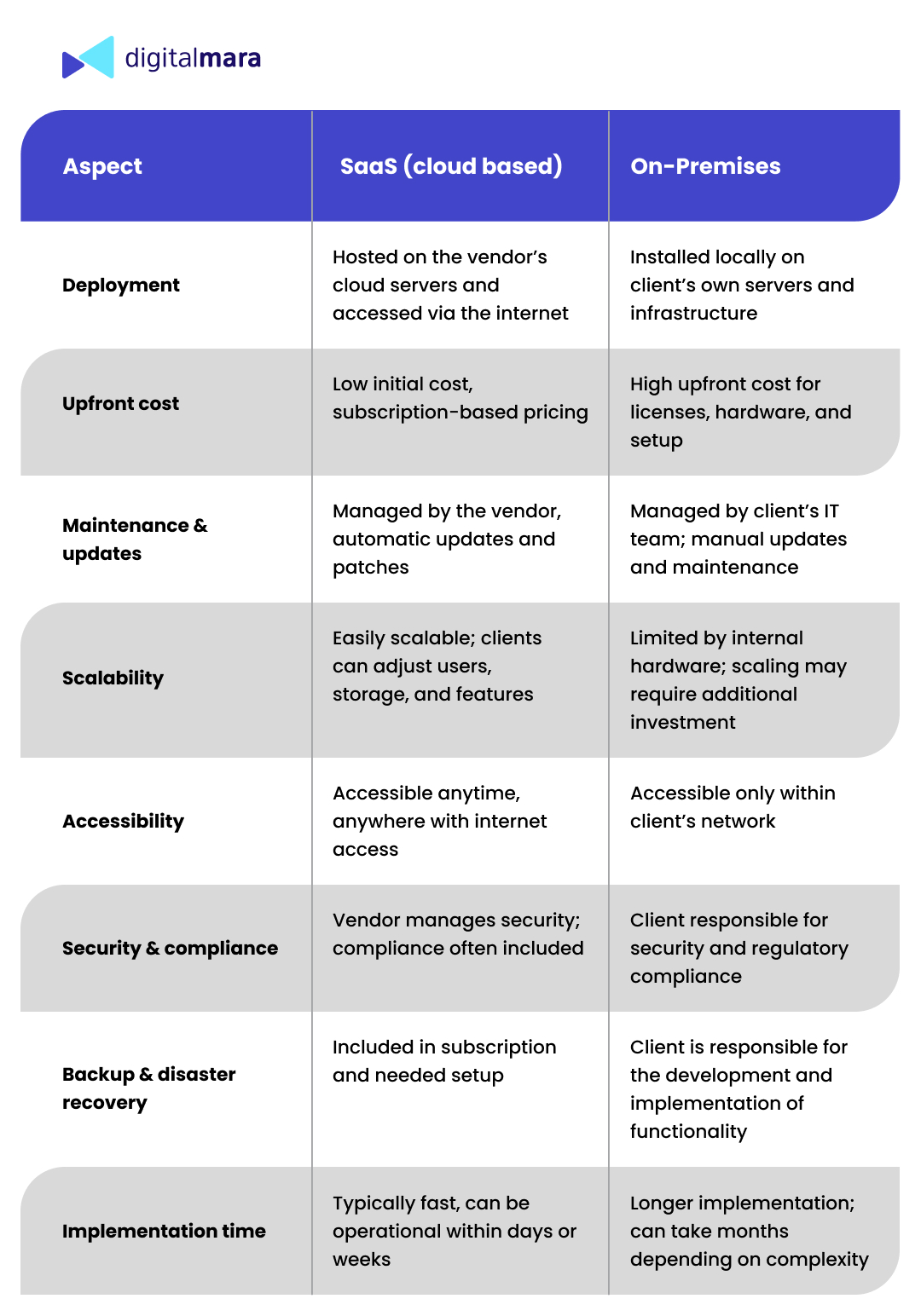
On-premises solutions require your own infrastructure, including software and hardware, while any updates to equipment and reconfiguration also demand additional investments. And don’t forget about management — the entire process, from setup to implementation, support and maintenance, is your responsibility. In contrast, SaaS means you will be paying a vendor for an established IT infrastructure. This is typically subscription-based; you only pay for resources and functionality that you actually use. In this way, on-premises software is costlier than SaaS.
Customization
With an on-premises system, your freedom to customize depends on the computational power of your infrastructure and your technical capabilities. You can integrate internal systems, third-party applications, and develop custom features tailored to your workflows. However, with this greater flexibility come added costs. You’ll need to ensure you have sufficient in-house technical expertise and infrastructure capacity.
SaaS is not as flexible in this regard. Customization opportunities are determined by the capabilities of your vendor. They typically provide configuration options for common business scenarios, which can cover the majority of use cases. Advanced customizations may not be possible, or may require additional development and coordination with the vendor.
Security
With on-premises solutions, you have full control over security policies and measures, and can implement the protocols considered most useful and effective for your environment. Responsibility for monitoring, updates, and incident response rests entirely on your internal team.
In SaaS models, responsibility for security is shared between the vendor and the client. Vendors typically provide strong baseline measures, such as data encryption, access management, and monitoring, while clients remain responsible for user management, internal policies, and compliance with regulations. Regardless of the model, security requires clear policies, continuous monitoring, and employee training to be effective.
Other features
- Scalability: SaaS solutions are generally more scalable, allowing you to add users or resources quickly without major infrastructure changes. On-premises systems may require significant hardware and software upgrades to scale.
- Backup: SaaS vendors typically handle backups and redundancy automatically. On-premises solutions require internal backup strategies and disaster recovery planning.
- Accessibility: SaaS platforms are accessible from any place that has an internet connection, supporting remote work and multi-location teams. On-premises solutions are usually limited to internal networks unless additional configurations, such as VPNs, are implemented.
- Performance: On-premises systems can provide faster performance for applications with high computational needs or low-latency requirements. Cloud performance may vary depending on network connectivity and vendor resources.
- Independence from Internet connectivity: On-premises software can operate without an internet connection, ensuring uninterrupted access to critical systems. SaaS solutions require reliable internet access, and disruptions can affect productivity.
Why the hybrid approach matters
In cases where neither on-premises nor SaaS meet all the company’s requirements, a hybrid approach is possible. Elements of both models are used to obtain the best combination of parameters. For example, you can keep sensitive data and critical systems on-premises for security and stability, and leverage the cloud for components that need scalability and remote access. Various studies show that a large percentage of companies choose this approach.
The hybrid model also provides greater business resilience. Workloads can be distributed between local and cloud environments, minimizing the risk of downtime and enabling smoother system-recovery strategies. Applications with intensive data processing can automatically scale to the cloud when needed, without requiring extra local hardware investment. Moreover, having resources in multiple environments helps reduce vendor lock-in and gives companies greater flexibility in designing their infrastructure.
Migration from on-premises to the cloud
Migrating from on-premises infrastructure to the cloud is a strategic decision that goes far beyond simply transferring data from one environment to another. Cloud servers and on-premises servers operate differently in how they store and process information. This transition requires thoughtful planning and technical expertise.
A successful migration begins with a comprehensive assessment of the existing system, including functions, integrations, databases, data flows, and dependencies. This stage often reveals the need to modernize a legacy system before the company can fully leverage cloud capabilities. The next step is to define the deployment option based on your security and compliance requirements, workload demand, and the need for customization. The cloud also offers alternatives such as public, private, and hybrid. Each option provides different levels of control, scalability, and cost-efficiency.
Once the assessment is complete and key strategic decisions are made, it’s time to move on to the technical phase of the migration. A smooth migration requires preparing your existing technology for a new operating environment. Legacy systems cannot be moved “as is” to a cloud environment. In many cases, system components must be redesigned and containerized to support elasticity and cloud-native functionality. It may be that integrations must be rebuilt or replaced with API-based connections.
Migrating data from on-premises systems to the cloud is one of the most critical and complex aspects of cloud migration. It’s not just copying. This transfer has to maintain data integrity, security, and availability throughout the process. The type of data also influences the type of new databases and type of cloud storage needed. Legacy systems often contain redundant, outdated, or inconsistent data. Cleaning and organizing it before migration reduces errors and accelerates the transfer process. The new system will receive high-quality and structured data.
Ensuring security and compliance is vital. Data should be encrypted during transit and at rest, with strict access controls and audit logging in place. It is also essential to adhere to industry-standard regulations and data protection standards such as GDPR and HIPAA.
With proper planning and the right technical team, businesses can make the move smoothly and unlock the full potential of cloud infrastructure.
AI integration in On-Premises and SaaS models
Artificial intelligence (AI) is becoming an integral part of modern software, enabling automation, data and image processing, and content creation. It can be implemented in both on-premises and SaaS models, but these models have different implications for control, performance, and technical requirements.
On-premises solutions provide full control over AI operations, which is particularly valuable for highly sensitive data or workloads that require strict security. However, implementing AI on-premises can be resource- and time-intensive. Companies must ensure sufficient computational power, storage capacity, and readiness of the infrastructure. The SaaS model makes it much easier to implement AI functionality quickly, leveraging the provider’s infrastructure to handle computing and scaling. Vendors also often provide special resources for AI features that can be integrated immediately into applications. However, this gives you less control over data handling.
A hybrid approach here is also a good option: running sensitive or critical AI workloads on-premises and using cloud infrastructure for non-sensitive, scalable, or external-facing workloads. It also enables teams to experiment with new AI capabilities in the cloud before deploying them to the on-premises environment, creating a flexible, adaptive ecosystem for AI-driven innovation.
Final words
Your choice of SaaS, on-premises, or a hybrid model depends on your technical, operational, and business priorities. Each approach offers advantages and challenges that must be carefully evaluated to build a secure, efficient, and scalable solution.
At DigitalMara, we help companies navigate these decisions with clarity and confidence. Our team has extensive experience designing and implementing cloud, on-premises, and hybrid architectures, integrating AI capabilities, and building software that aligns with industry standards and regulatory requirements. We translate complex technical needs into practical, future-ready solutions tailored to each client’s needs.
Whether you’re planning a new system or optimizing an existing one, DigitalMara provides engineering expertise to support your goals and ensure a smooth implementation.
Choose our custom software development or team augmentation services.