







The measurable impact of AI is profitability, new revenue streams, and competitive advantage. However, many companies struggle to move from experiments to fully operational AI because their systems and processes are not yet prepared. Understanding whether your digital infrastructure, data, and culture are ready is essential to ensuring that AI delivers real business value. DigitalMara has prepared this guide to help you identify the key indicators of AI readiness and practical steps to make AI work effectively within your company.
According to the CISCO AI Readiness Index 2025, there are six key pillars that demonstrate a company’s readiness to successfully adopt AI:
- Clear AI strategy
- Robust infrastructure
- Clean and centralized data
- Governance with guardrails and live monitoring
- In-house AI talent
- Internal AI culture
These pillars highlight that AI readiness is not only a technological challenge. It requires alignment between strategy, systems, data, and people. Companies that successfully deploy AI tend to treat it as a business transformation initiative rather than simply introducing a new tool. Strategy defines how AI supports business goals, while governance ensures responsible and secure use of data and models. Talent and culture, in turn, determine whether teams are able to experiment with AI and integrate it into the company’s workflows.
Infrastructure and data remain two of the most critical foundations. AI systems require powerful computing resources, scalable networks, and secure environments capable of handling intensive workloads. At the same time, data must be accessible, consistent, and properly managed. Fragmented or poorly governed data often becomes one of the main obstacles to scaling AI initiatives.
AI agents and modern generative models further increase the demands placed on enterprise systems. They rely on large volumes of data, constant interaction with digital platforms, and continuous processing. This means that companies must rethink how their infrastructure is designed, monitored, and maintained. Traditional enterprise systems were not always built to support this level of computational intensity or real-time orchestration.
Recognizing systems that are not yet suitable for AI adoption
Research from Gartner, TechTarget, and other industry observers shows that legacy IT environments built for rigid workflows often lack the flexibility, scalability, and integration needed to support modern AI initiatives. Traditional systems were not designed for continuous real‑time processing, iterative learning cycles, or dynamic data ingestion, which are core requirements for successful AI adoption. When companies overlook these gaps, AI efforts tend to stall in the pilot phase and fail to deliver measurable business value.
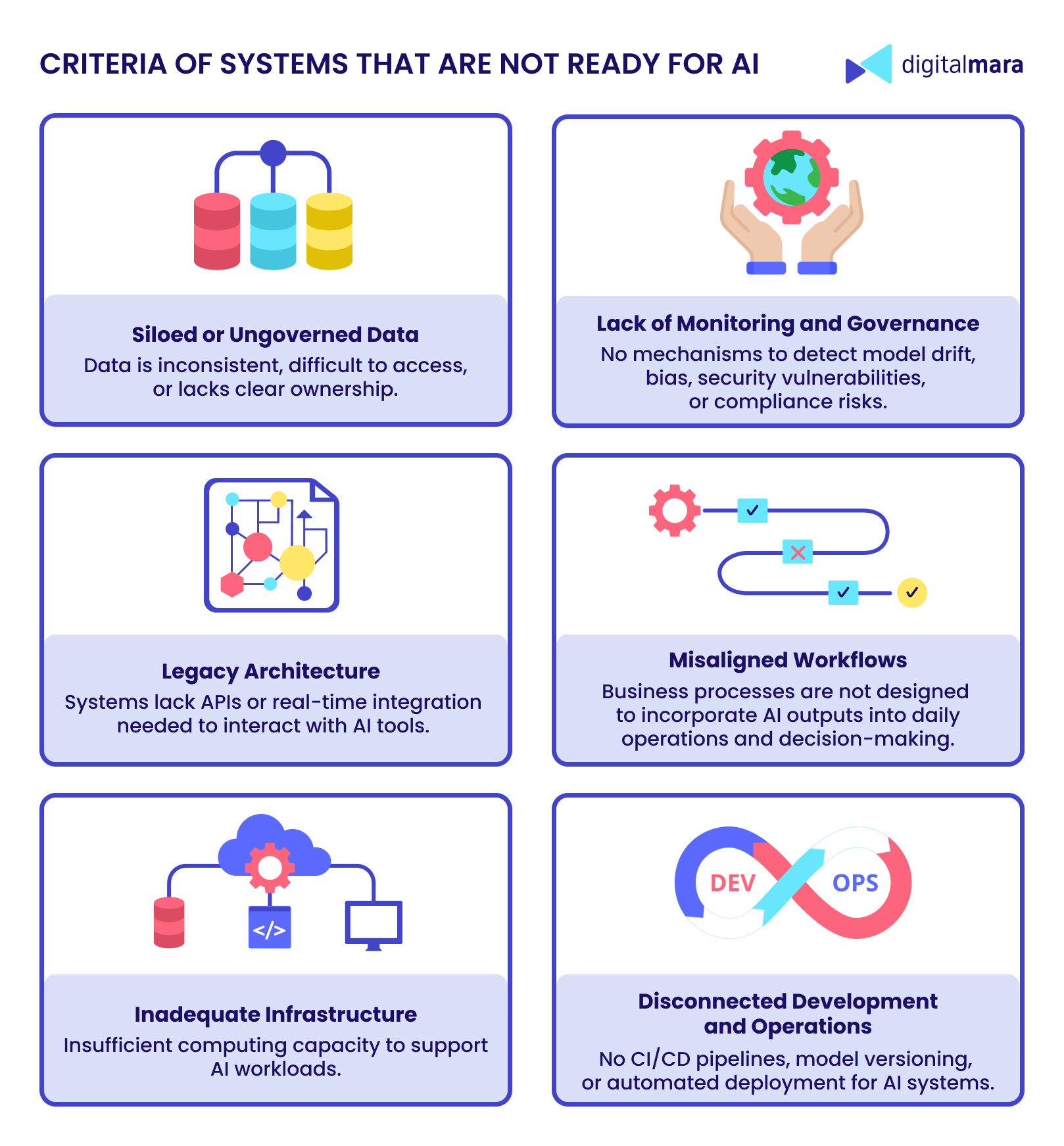
One clear indicator that a system is not ready for AI is fragmented or siloed data. As Gartner notes, many companies lack centralized data management and proper governance, which results in inconsistent quality, inaccessible data pools, and unreliable data sources for training and inference. AI systems depend on unified data pipelines that can serve consistent, well‑labeled information across the enterprise. When data remains scattered across poorly integrated databases without standard formatting or governance standards, models struggle to learn effectively and deliver unpredictable or erroneous outcomes.
In addition to data challenges, many core enterprise applications lack modern integration capabilities. AI solutions must interact with operational systems such as ERP, CRM, and IoT platforms through robust APIs or middleware. However, older systems may only support batch processing or one‑way data flows, making it difficult for AI agents and models to interact dynamically with business processes. This creates brittle or ad‑hoc solutions that work only in controlled demonstrations rather than live environments. When systems cannot natively exchange data in real time or support scalable integration, the infrastructure is not suited for operational AI.
Another crucial dimension is computing and infrastructure capability. Many organizations depend on on‑premises hardware or frameworks that were never designed for large‑scale AI workloads. AI, especially generative models and autonomous agents, requires high‑performance compute, elastic scaling, and often GPU or cloud‑based acceleration. Systems that lack these capabilities will simply be unable to handle AI’s demands without significant redesign or extension. As industry practitioners point out, infrastructure that cannot scale with peak data and model loads or cannot support automated deployment pipelines is fundamentally unready for production‑grade AI.
Finally, beyond technology, systems that are poorly prepared often reflect organizational and operational immaturity. When governance frameworks, monitoring mechanisms, and compliance guardrails are missing, AI deployments become risky or inconsistent. Without clear policies for testing, bias mitigation, and live monitoring, AI outputs can introduce legal, ethical, or performance issues. This highlights that readiness is not just about hardware and software, but also about processes, culture, and strategic alignment.
Identifying opportunities for AI adoption
Once companies recognize which systems are not yet suitable for AI, the next step is to focus on areas where AI can deliver real value. Success depends not only on technology but also on business alignment, data readiness, and operational integration. Companies that begin with high-value opportunities supported by sufficient data and clear workflows are far more likely to achieve measurable outcomes, scale AI initiatives effectively, and earn organizational trust.
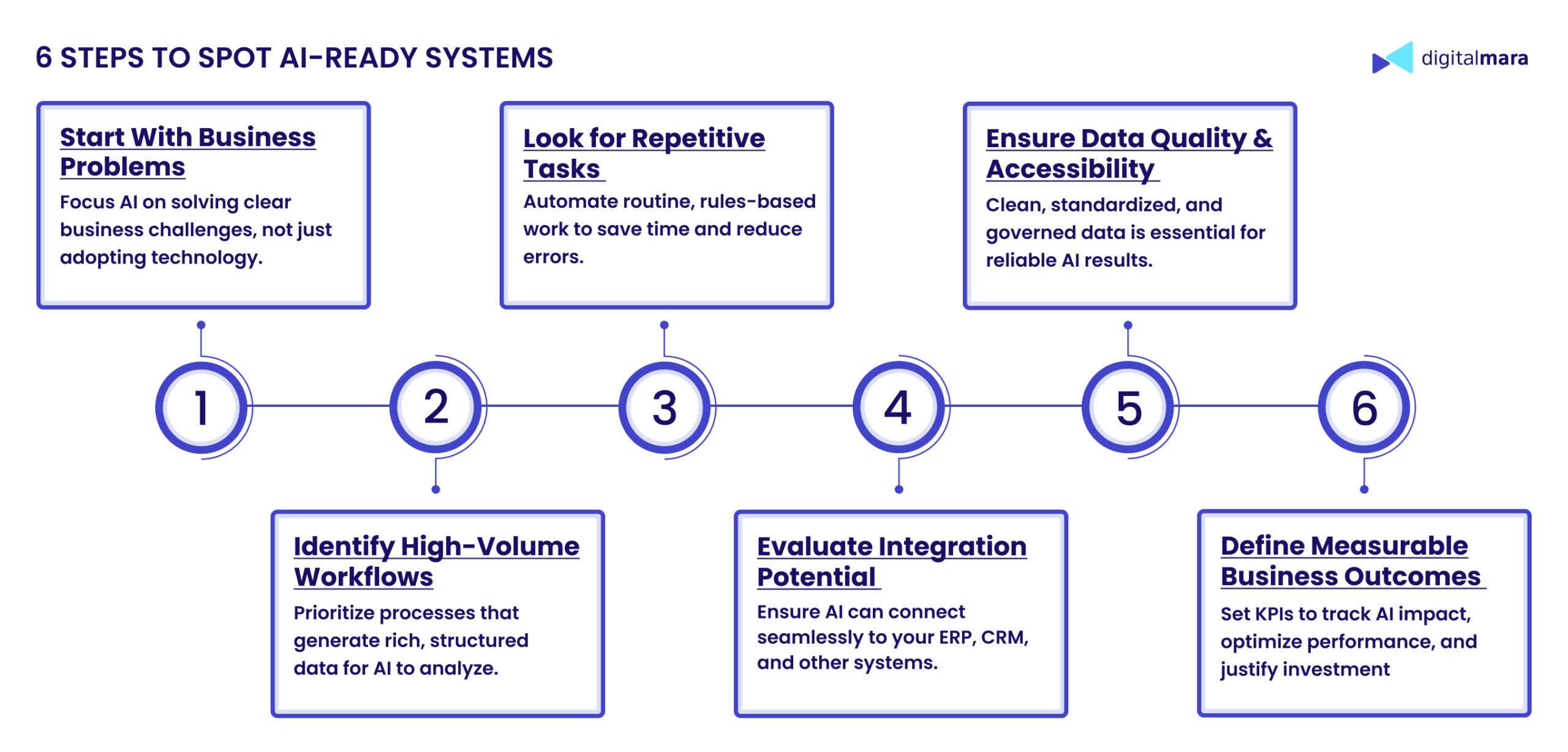
Start with business problems, not technology
AI adoption often fails when companies focus on the technology itself rather than the problem it aims to solve. Gartner emphasizes that AI projects should begin with well-defined business objectives such as reducing operational costs, improving customer experience, or optimizing supply chain performance. By mapping AI to specific goals, organizations can prioritize initiatives that deliver measurable impact while avoiding wasted investment on unnecessary technologies. Furthermore, starting with business problems ensures alignment across IT, data teams, and business units, creating a foundation for successful implementation. Pilot projects guided by business outcomes also allow companies to validate ROI before scaling.
Identify workflows with high data volume
AI models thrive on large volumes of quality data. Deloitte notes that processes generating rich, structured, or semi-structured data, such as customer interactions, sensor logs, and transaction histories, are particularly well-suited for AI. These workflows provide the statistical foundation needed for predictive and generative models. Companies should identify areas where sufficient historical data exists, ensuring that AI models can be trained effectively and produce reliable predictions. Prioritizing high-volume workflows also accelerates the learning curve, enabling faster deployment and measurable early wins.
Look for repetitive tasks
Repetitive, rules-based, and time-consuming tasks are prime candidates for AI automation. McKinsey highlights that such workflows can be automated with minimal risk while delivering significant operational efficiency. Examples include routine reporting, invoice processing, compliance checks, and customer service queries. By automating repetitive tasks, companies can free employees to focus on higher-value work, reduce errors, and accelerate process cycles. These early AI wins also help build organizational confidence, demonstrating the tangible benefits of AI while preparing teams for more complex projects.
Evaluate integration potential
The ability to integrate AI solutions with existing systems is critical for operational adoption. IDC notes that AI pilots often fail when models cannot interact seamlessly with ERP, CRM, or IoT platforms. Assessing integration potential ensures that AI outputs are actionable, flowing directly into decision-making processes rather than remaining isolated in dashboards. Companies should evaluate API availability, middleware compatibility, and real-time data exchange capabilities. Strong integration also allows AI insights to trigger automated workflows, enabling continuous optimization and supporting live operational decision-making.
Ensure data quality and accessibility
High-quality, accessible data is the backbone of reliable AI. Forrester highlights that poor-quality, inconsistent, or siloed data is one of the primary barriers to effective AI deployment. Companies must prioritize data governance, standardization, and accessibility across business units. Data pipelines should provide timely, accurate, and structured datasets for training and inference. Moreover, secure and compliant data access ensures that AI systems can operate safely while meeting regulatory requirements. By addressing these aspects, organizations increase model accuracy, reliability, and trust in AI outputs.
Define measurable business outcomes
Every AI initiative should tie directly to specific, measurable business outcomes. Harvard Business Review emphasizes that setting clear KPIs, such as cost reduction, efficiency improvement, revenue growth, or customer retention, allows companies to track AI impact and optimize performance. By defining these outcomes upfront, companies can prioritize AI initiatives that offer the greatest ROI, allocate resources effectively, and provide transparency to stakeholders. Measuring results also creates a feedback loop, enabling iterative improvement and helping to scale successful pilots into enterprise-wide solutions.
Introduce AI without disrupting core operations
Introducing AI into core business processes can unlock tremendous value, but doing so without jeopardizing existing operations requires careful design and execution. According to McKinsey, the most successful AI transformations introduce new capabilities incrementally while preserving the stability of mission‑critical systems, rather than attempting a “big bang” deployment that can cause outages or resistance across teams. Starting with scoped pilots that coexist with legacy workflows allows companies to validate impact, uncover integration challenges early, and build confidence before doing a broad rollout.
One of the key principles is to implement in phases. Rather than replacing core systems immediately, companies should begin with non‑critical processes or adjacent workflows that still provide meaningful outcomes. For example, customer support routing, financial forecasting, or analytics dashboards. This approach minimizes risk by reducing dependency on AI for mission‑critical functions until its reliability is proven.
Another important aspect is establishing hybrid operations during the transition. For example, AI models can be deployed in decision‑support roles where human experts retain control over final decisions, rather than fully automating processes upfront. Such an approach allows companies to capture the benefits of AI while maintaining human oversight, accountability, and the ability to intervene early if outputs deviate from expectations. Hybrid workflows also provide a valuable feedback loop for refining models, improving accuracy, and building trust among operational teams.
Finally, strong governance and monitoring frameworks ensure that AI introduction does not degrade performance, compliance, or user experience within core systems. Forrester notes that real‑time model monitoring, automated rollback triggers, and cross‑functional review boards help organizations detect and respond to deviations early. These controls act as guardrails, enabling AI innovation while keeping operational stability front and center.
Final words
Companies should adopt a holistic approach to determining their AI readiness, considering not only technology but also strategy, data, infrastructure, and organizational culture. Successful AI adoption requires understanding which systems are ready, which workflows can benefit most, and how to introduce AI incrementally without disrupting core operations. With a structured approach, companies can move confidently from AI exploration to enterprise-wide adoption, unlocking new value and future-proofing their operations.
At DigitalMara, we help organizations navigate the complexities of AI adoption. From assessing AI readiness to identifying high-value opportunities for design, implementation, and scaling AI solutions, our team provides end-to-end support.
Learn more about our expertise and AI development services.