



Agentic AI Development
DigitalMara develops custom AI agents that perform end-to-end tasks across various workflows and departments. They can be seamlessly integrated with your systems and ensure reliable process execution.
Benefits of implementing AI agents
Workflow automation
AI agents canindependently analyze complex scenarios, make contextual decisions, and perform multi-step workflows without constant human intervention.
Decision support
AI agents process large volumes of data in real time, providing insights and recommendations that support faster, more informed decision-making.
Increased accuracy & fewer human errors
By following defined logic and validated data, AI agents reduce the risk of manual mistakes and ensure more consistent outcomes.
Operational resilience & scalability
AI agents adapt to changing workloads and operate reliably under varying conditions, enabling systems to scale without compromising performance.
Increased productivity & efficiency
AI agents operate 24/7, handling repetitive and time-consuming tasks, allowing teams to focus on higher-value activities.
Cross-system operations
AI agents integrate with multiple tools, platforms, and databases, allowing seamless data flow and end-to-end process execution.
Cost efficiency & resource optimization
AI agents let you use your resources more efficiently and save money by automating repetitive workflows, reducing manual errors, and efficiently scaling operations across the company.
Types of AI agents we develop
DigitalMara can develop various kinds of AI agents, tailored to specific business needs, workflows, and operational environments. Each type is designed to solve a distinct category of tasks and fit seamlessly into your processes.
Task automation agents

Task automation agents are designed to execute repetitive and structured workflows with minimal human intervention. We use workflow orchestration logic, event-driven triggers, and structured execution pipelines. Execution flows are engineered for deterministic behavior across multi-step processes. By integrating these agents with APIs, internal systems, and data sources, we enable reliable end-to-end execution of processes. State management, error recovery, and retry mechanisms are introduced to ensure stability in production environments.
Decision-making agents

Decision-making agents evaluate data, apply defined rules or learned patterns, and support or execute decisions in real time. They are implemented through decision pipelines that combine rule engines, Machine Learning models, and structured inference layers. Modular decision flows help to ensure that logic execution is transparent and traceable. Validation checkpoints and constraint-based logic control execution paths. We also introduce monitoring layers to track the quality of decisions and system behavior over time.
Data analysis agents

Data analysis agents process large volumes of structured and unstructured data from multiple sources. Implementation relies on ETL pipelines, transformation layers, and analytical computation workflows. We build scalable architecture that supports both batch and real-time processing. Efficient ingestion and processing systems ensure consistent data handling across sources. Outputs are integrated into reporting and decision systems for downstream use.
Customer interaction agents

Customer interaction agents manage communication with users across channels such as chat, email, or internal platforms. Implementation is based on conversational engines, context management systems, and CRM integrations. Dialogue systems are structured to maintain context across multi-turn interactions. We implement intent recognition and retrieval mechanisms to support consistent response behavior. Seamless system integration enables end-to-end handling of customer workflows.
Multi-agent systems
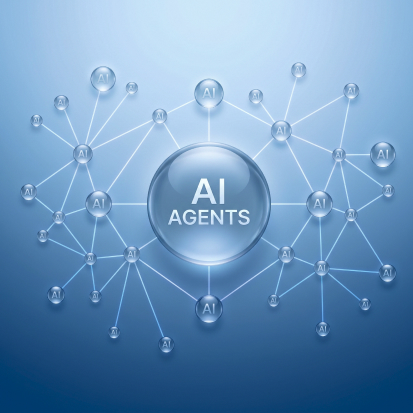
Multi-agent systems include specialized agents such as planners, retrievers, executors, and verifiers that collaborate to complete complex, cross-functional tasks. We ensure that sequencing, shared memory, and conflict resolution are coordinated across agent networks that may span various departments, systems, and data domains. Execution is managed through orchestration logic that defines how agents delegate, communicate, and validate intermediate outputs. System behavior is structured around controlled execution flows, with clear dependency-tracking between agents. We add monitoring layers to observe inter-agent interactions and ensure consistent system-level performance.
Research & knowledge agents

Research & knowledge agents collect, process, and synthesize information from multiple internal and external sources. We use retrieval pipelines, embedding models, and knowledge indexing systems. Agent architecture supports semantic search and contextual retrieval over large datasets. RAG-based frameworks handle structured information synthesis. We ensure that sources can always be traced for validation and auditing.
Monitoring & alerting agents

Monitoring & alerting agents continuously track systems, workflows, and data streams to detect anomalies or critical events. Streaming data pipelines, event processing systems, and anomaly detection models form the foundation. Continuous execution environments ensure observability across systems, while event-driven mechanisms handle detection and alert generation. We implement logging and monitoring layers that support diagnostics and system analysis.
Personal assistant agents
Personal assistant agents support users with task management, scheduling, and information retrieval. We build them using tool-calling frameworks, context management systems, and external API integrations. User intent is interpreted through interaction layers that trigger the appropriate system actions. Context is preserved across sessions to ensure continuity in ongoing tasks. Integration with productivity tools enables full end-to-end task execution workflows.
Recommendation agents

Recommendation agents analyze user behavior, preferences, and contextual data to generate personalized suggestions. We implement them using ranking models, feature pipelines, and real-time inference systems. Scoring and ranking architectures make it possible to generate recommendations dynamically. Continuous feedback loops improve adaptability and quality of output over time. By processing streaming data, it’s possible to personalize recommendations in real time.
IT operations agents
IT operations agents support infrastructure management, system monitoring, and routine IT operations. We implement them using automation pipelines, monitoring systems, and infrastructure APIs. Systems are designed with built-in observation and control mechanisms to maintain visibility and reliability. Automated detection and remediation systems can address operational issues as they occur. Deployment and configuration management processes ensure stable and consistent system performance.
Our AI agent development services
We are working on every aspect of AI agent development. Our agents can manage complex workflows, coordinate across tools and data sources, and operate within governance requirements.
-
AI agent strategy & consulting
-
Custom AI agent development
-
AI Agent workflow & data mapping
-
AI Agent training
Our agentic AI consulting service is aimed at identifying the most effective automation opportunities, the kind that deliver measurable business value while meeting legal and operational requirements. We evaluate your business processes, data landscape, and technical infrastructure to identify areas where adopting AI agents will make the greatest impact. Based on this, we suggest priority use cases and a clear roadmap for implementing them that is aligned with your business goals, governance standards, and scalability needs.
We base the development of each agent on the logic of your particular business, not on general patterns. Each agent is created in keeping with specific goals, planning levels, pipelines, and constraints on decision-making. We can connect your agents to ERP platforms, CRM systems, internal databases, third-party APIs and cloud data warehouses, which allows the agents to receive operational information, perform follow-up actions, and work within your existing security perimeter. This ensures that every solution is designed for reliable performance in real-world workflows.
We design and structure how AI agents operate within your business processes to ensure accurate, predictable, and scalable execution. This includes mapping workflows from end to end, defining system dependencies, and aligning interactions between internal and external tools. We also establish how your agents access, interpret, and transform data across systems, ensuring consistency, traceability, and correct decision-making across all steps of execution.
We train agents on your domain-specific data, validate reasoning patterns, optimize decision accuracy, and conduct robustness-testing under edge-case scenarios. The result is a domain-calibrated agent with proven decision accuracy and transparent, well-documented failure-handling mechanisms. We further refine agent behavior through iterative testing, performance evaluation, and feedback loops based on real-world usage, ensuring continuous improvement in accuracy, reliability, and adaptability over time.
-
AI agent strategy & consulting
Our agentic AI consulting service is aimed at identifying the most effective automation opportunities, the kind that deliver measurable business value while meeting legal and operational requirements. We evaluate your business processes, data landscape, and technical infrastructure to identify areas where adopting AI agents will make the greatest impact. Based on this, we suggest priority use cases and a clear roadmap for implementing them that is aligned with your business goals, governance standards, and scalability needs.
-
Custom AI agent development
We base the development of each agent on the logic of your particular business, not on general patterns. Each agent is created in keeping with specific goals, planning levels, pipelines, and constraints on decision-making. We can connect your agents to ERP platforms, CRM systems, internal databases, third-party APIs and cloud data warehouses, which allows the agents to receive operational information, perform follow-up actions, and work within your existing security perimeter. This ensures that every solution is designed for reliable performance in real-world workflows.
-
AI Agent workflow & data mapping
We design and structure how AI agents operate within your business processes to ensure accurate, predictable, and scalable execution. This includes mapping workflows from end to end, defining system dependencies, and aligning interactions between internal and external tools. We also establish how your agents access, interpret, and transform data across systems, ensuring consistency, traceability, and correct decision-making across all steps of execution.
-
AI Agent training
We train agents on your domain-specific data, validate reasoning patterns, optimize decision accuracy, and conduct robustness-testing under edge-case scenarios. The result is a domain-calibrated agent with proven decision accuracy and transparent, well-documented failure-handling mechanisms. We further refine agent behavior through iterative testing, performance evaluation, and feedback loops based on real-world usage, ensuring continuous improvement in accuracy, reliability, and adaptability over time.
Technologies in AI development
Our expertise spans a wide range of tools, frameworks, and platforms, enabling us to develop scalable, reliable, and high-performance AI solutions. We select a tech stack based on each project’s requirements.


Related insights


FAQ
-
What are AI Agents and how do they work?
AI agents are software systems that can perceive input, make decisions, and execute actions to achieve specific goals. They combine models, tools, and system integrations to work through defined workflows or respond dynamically to changing conditions. In practice, they act as an execution layer that connects data, logic, and external systems, allowing tasks to be completed end-to-end with minimal manual intervention.
-
What is the difference between AI Agents and traditional automation or RPA?
Traditional automation and RPA rely on fixed rules and predefined workflows, which makes them effective for repetitive but predictable tasks. AI agents, on the other hand, can interpret context, work with unstructured data, and make decisions during execution. This allows them to handle more complex, variable, and multi-step processes where rules alone are not enough.
-
What business processes can AI agents automate?
AI agents can automate a wide range of operational and knowledge-driven processes across different departments. Common use cases include document processing, reporting, customer support, data handling, and internal workflow automation. They are particularly valuable in processes that require coordination between multiple systems or involve decision-making at different stages.
-
Can AI Agents integrate with our existing systems?
Yes, AI agents are designed to work within existing IT environments without requiring system replacement. They can connect to APIs, databases, CRMs, ERPs, and internal tools to read and act upon live business data. This allows them to become an additional intelligence layer on top of your current infrastructure, rather than a separate system.
-
How can we get started with AI agent development?
It usually starts with a discovery phase where business processes, data sources, and goals are analyzed. Based on this, key use cases are identified and prioritized depending on their feasibility and potential impact on the business. From there, a clear implementation roadmap is defined that covers design, development, testing, and deployment stages.
-
What technologies are used to build AI agents?
AI agents are typically built using a combination of core technologies, including:
- large language models,
- orchestration frameworks (e.g. LangChain, LlamaIndex, Semantic Kernel),
- APIs and external system integrations (REST, GraphQL, webhooks),
- data infrastructure components such as databases and vector stores (PostgreSQL, MongoDB, Pinecone, Weaviate).
Depending on the use case, they may also include:
- machine learning models (PyTorch, TensorFlow, Scikit-learn),
- rule engines (Drools, custom policy engines),
- streaming data pipelines (Kafka, Apache Flink, AWS Kinesis).
-
What happens if the AI Agent makes a mistake?
AI agents can make various types of mistakes. Each has a different cause and requires a specific mitigation approach:
- Context degradation – the agent gradually loses important context during long or complex interactions.
Solution: We mitigate this by using structured memory systems, periodic context summarization, and retrieval-augmented generation (RAG), which allows the agent to re-access relevant information instead of relying only on limited short-term context.
- Specification drift – the agent slowly deviates from the original instructions or intended goal.
Solution: We address this through continuous instruction validation, step-by-step task decomposition, and checkpointing mechanisms that re-verify alignment with the original objective before proceeding.
- Sycophantic confirmation – the agent tends to agree with incorrect assumptions instead of correcting them.
Solution: We reduce this risk by incorporating adversarial prompting, fact-checking layers, and confidence scoring that flags uncertain or potentially incorrect responses for review or correction.
- Tool errors – failures occur when interacting with external tools, APIs, or systems.
Solution: We implement robust API validation, retry logic with exponential backoff, structured error handling, and fallback execution paths to ensure continuity when tools fail.
- Cascading failure – a single early mistake propagates and compounds into larger downstream errors.
Solution: We prevent this through modular execution design, intermediate result validation, and rollback or correction points that isolate and contain errors before they propagate.
- Silent failure – the agent produces incorrect outputs without obvious error signals.
Solution: We apply output verification checks, anomaly detection systems, and consistency validation against expected patterns or constraints to detect and reveal hidden failures.